Beyond Search Ads
Most Amazon advertisers live in the world of PPC. Click-based, intent-driven, bottom-of-funnel. And for good reason — PPC is the closest lever to the dollar. It's where the immediate ROAS lives.
But here's the problem: eventually, you hit a ceiling.
You've optimized your bids, your targeting is tight, your ACOS is dialed. Yet growth has flatlined. You're spending more but getting less — diminishing returns on every incremental dollar. The search-only strategy that got you to $1M/month might not get you to $5M.
That's where Amazon DSP and Amazon Marketing Cloud come in.
DSP lets you reach Amazon's shoppers beyond the search bar — through display, video, and streaming TV — using the same audience data that makes Amazon's ad ecosystem so powerful. AMC gives you the analytics layer to prove it's actually working and build audiences with surgical precision.
PPC captures existing demand. DSP creates new demand and expands the funnel. AMC proves the whole thing is working — and tells you where to invest next.
This guide distills everything our team has learned about DSP and AMC — from managing DSP campaigns at scale to auditing accounts spending hundreds of thousands per month. No black boxes. No hype. Just the frameworks, tactics, and mental models that actually work.
Why DSP Matters for Amazon Brands
The Limitation of Search-Only Strategies
Search advertising is reactive by nature. A customer types a query, you bid on it, your ad shows up. It's incredibly effective — but it only captures people who are already looking.
What about everyone else? The shoppers browsing competitor products. The loyal customers who haven't reordered in two months. The in-market audience who's been researching your category but hasn't searched your specific product yet.
PPC can't reach them. Through DSP & AMC, you can.
The right time to start using DSP is when you start to see some sort of a tail-off in performance with incremental PPC spend. You've maximized what you're able to spend efficiently — then DSP becomes the next lever. PPC should always be the lion's share of your budget. But when you start to see performance taper off, DSP is an awesome next step.
What DSP Actually Is
Amazon DSP (Demand-Side Platform) is Amazon's programmatic advertising platform. It lets you buy display, video, and audio ads that appear across Amazon's owned properties (Amazon.com, IMDB, Twitch, Alexa, Fire TV) and third-party websites and apps.
The key differences from Sponsored Ads:
| Feature | Sponsored Ads (PPC) | Amazon DSP |
|---|---|---|
| Pricing model | Cost-per-click (CPC) | Cost-per-thousand impressions (CPM) |
| Targeting | Keywords, products, categories | Audiences, behaviors, browsing history, life events |
| Placement | Amazon search results, product pages | Amazon + Twitch + IMDB + Alexa + third-party sites |
| Ad formats | Text, image, video (limited) | Display, video, OTT/streaming TV, audio |
| Brand requirement | None (SP) / Brand Registry (SB) | Brand Registry or agency access |
| Best for | Capturing intent, driving immediate sales | Building audiences, retargeting, brand awareness |
The CPM Model: Different Rules, Different KPIs
The biggest mental shift for PPC managers moving to DSP: you pay for impressions, not clicks.
In PPC, a low review count means someone might not click your ad — but you don't pay for that. In DSP, you get charged regardless. A product with low reviews, bad images, or poor social proof will bleed money on impressions that never convert.
Running DSP for products with fewer than 100 reviews or below a 4.5-star rating. Because you're charged on impressions, products that don't convert from display traffic will burn through budget with nothing to show for it. Review count and quality are prerequisites, not nice-to-haves.
DSP Is Not Sponsored Display
Many advertisers confuse DSP with Sponsored Display. While they share some DNA, DSP is significantly more powerful. Think of Sponsored Display as a preview — if your products perform well there, DSP is the next level. It opens up the full catalog of Amazon's ASIN-based audiences, custom audience creation, much finer control over bidding and placement, and streaming TV capabilities that Sponsored Display simply can't touch.

The Full-Funnel Framework
Where DSP Fits in Your Advertising Stack
The biggest mistake brands make with DSP is treating it in isolation. DSP doesn't replace PPC — it extends your reach above it in the funnel and reinforces it below with retargeting.
DSP spans the entire funnel — PPC lives primarily in the Conversion layer

How DSP and PPC Work Together
In an ideal world, the relationship looks like this: DSP introduces a shopper to your brand at the top of the funnel. They see a display ad while browsing. Later, they search for your category — your PPC ad appears and they click. Maybe they don't buy yet. DSP retargets them the next day. They come back, search your brand name, and purchase.
The last click attribution goes to PPC. But DSP started the entire journey.
It's important to look at your holistic data when you're evaluating a platform versus just taking exactly what the platform's telling you. Every advertising platform loves claiming sales. PPC influences organic rank. DSP can influence PPC and organic too. You have to look at these things together — not in silos.
Budget Allocation: The 10-20% Rule
As a starting point, we recommend incrementally adding 10-20% of your PPC budget toward DSP. PPC should generally be the lion's share. But once you're seeing diminishing returns on search spend, that 10-20% in DSP can create outsized impact.
For a brand spending $100K/month on PPC, that means starting with $10-20K/month on DSP. You can start even smaller — $5K is a reasonable test budget for brands ready to experiment.
Always grow with success instead of throwing a bunch of money at DSP and shrinking with failure. Start small, prove the concept, and scale what works. The platform's not for everyone, but if you hit the readiness criteria, it's almost always worth a test.
Getting Started with DSP
DSP Readiness Checklist
Not every brand is ready for DSP. Running it too early is one of the most common reasons advertisers have a bad first experience — and then incorrectly conclude "DSP doesn't work."
Access: Getting a DSP Seat
Amazon DSP access works differently from Sponsored Ads. You can't just log into Seller Central and start running campaigns. There are two paths:
- Amazon-managed service: Amazon runs campaigns for you. Historically required $50K+/month minimum spend. Amazon sets up the campaigns and makes optimizations.
- Self-service via an agency or tech partner: Agencies with their own DSP seat manage your campaigns. Far more flexible, better control, and lower minimums — often $5-10K/month.
For most brands, the agency or tech partner route is the way to go. You get human expertise, granular control, and far lower barriers to entry.

Campaign Structure: Start Bottom-Up
When launching DSP, work your way up the funnel — don't start with awareness campaigns.
Week 2-3: Mid-funnel (similar product views, in-market)
Week 3-4: Upper funnel (lifestyle, contextual, STV)
Ongoing: Optimize, cut losers, scale winners
Start with retargeting because these are the easiest wins. People already know your product — they just need a nudge. Mid-funnel campaigns target people browsing your category or competitors. Upper funnel introduces your brand to new audiences entirely.
Custom audiences are the backbone of DSP. You're creating audiences based on how people browse and purchase on Amazon — using any ASIN on the platform, with lookback windows from 2 to 365 days.
Beyond that, Amazon has over 10,000 pre-created audiences covering in-market segments (recent browsing behavior), lifestyle segments (consistent behaviors over time), and demographic targeting.
But here's the thing: 99.9% of those won't be effective for any given brand. The power is in customizing for your specific products and competitive landscape.
Getting Creative with Audiences
Don't just think about someone who's in-market for your category. Think about complementary products. What else does your target customer buy? A supplement brand might target people who recently purchased a yoga mat, a fitness tracker, or a blender. Test as much as possible — some of the best results come from targeting complementary products rather than direct competitors.
For static display, we're close to 100% responsive e-commerce creatives. Even if you have custom images, you can add them within a responsive e-commerce ad while keeping the Prime badge, price, star rating, and Add to Cart button.
These elements matter enormously. Responsive e-commerce ads look like Amazon native content — they have the Prime badge, the Add to Cart button, and the star rating. That credibility drives clicks.
If you're a third-party seller, there's a checkbox under responsive e-commerce ad settings called "Enable 3P Price." If you don't check it, your pricing, Prime badge, and Add to Cart button won't pull in. We've seen conversion rates double when this is enabled. Check every account — this gets missed constantly.
Measure DSP's True Impact
AdLabs helps you actually see whether your DSP campaigns are lifting the whole account or just cannibalizing organic. The holistic view most advertisers never get.
Try Free →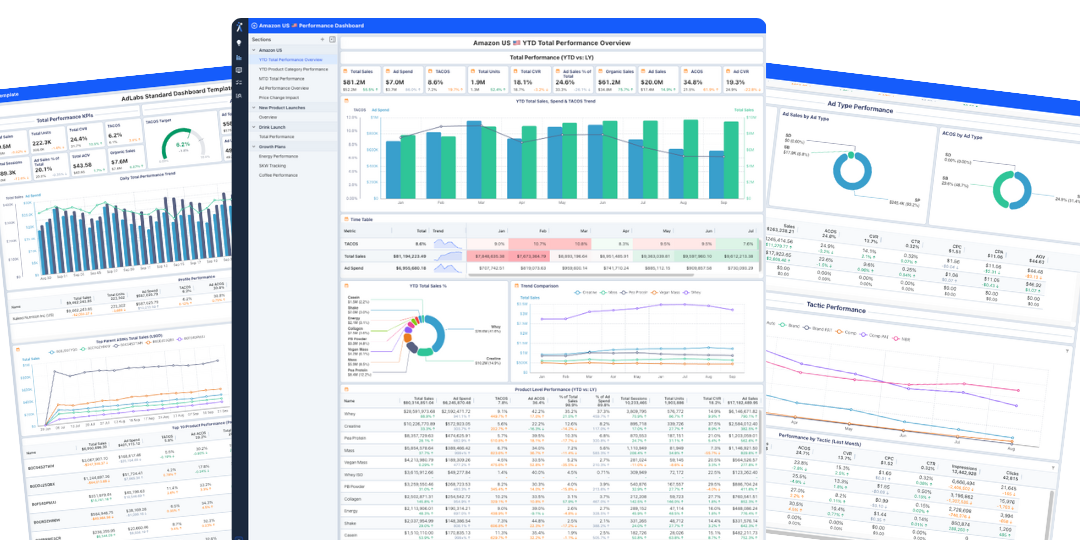
The 5-Step DSP Audit
We've audited hundreds of DSP accounts. These are the five issues we find in 90%+ of them. If you're running DSP right now, go through this checklist. You'll likely find money being wasted.
Step 1: Viewability — Are Your Ads Actually Being Seen?
This is the #1 issue by a wide margin. Because DSP charges on a CPM basis, you pay for every impression — whether anyone sees the ad or not.
Probably 80% of the accounts we look at have a viewability issue. If you're spending any amount and you have a 5% viewability rate, you're just serving invisible ads all day. You're being charged for a million impressions, but fewer than 100,000 were actually seen.
An ad is considered "viewable" when at least 50% of its pixels are visible in the browser window for at least one continuous second. If an ad loads at the bottom of a page that nobody scrolls to — you still pay.
The Viewability Fix
- Set viewability minimums. Start at 40-50% minimum. This ensures you're only bidding on placements where at least that percentage of viewers actually see the ad.
- Bid higher, not lower. Counter-intuitive, but higher bids get you more prominent placements — bigger ads, higher on the page. We almost never see accounts bidding too high. The problem is almost always underbidding.
- Target 75-90%+ actual viewability. Setting a 50% minimum threshold with healthy bidding often results in 70-80% actual viewability, which is healthy.
A $3 CPM looks great on paper. But if your viewability rate is 5%, your effective CPM (cost per seen impression) is actually $60. Meanwhile, a $15 CPM with 90% viewability gives you an effective CPM of $16.67. The "expensive" option is actually 4× cheaper per impression that matters.
Step 2: Inventory Breakdown — On-Amazon vs. Off-Amazon
By default, DSP campaigns target everywhere — Amazon, third-party sites, apps, everything. Most advertisers don't realize that the vast majority of their spend could be going off-Amazon where performance is fundamentally different.
What always happens is either no ads are being shown on Amazon or no ads are being seen on Amazon. And they're lighting money on fire because they didn't break out their inventory types and didn't bid appropriately for each.
The Inventory Fix
- Separate line items for on-Amazon vs. off-Amazon. Never combine them.
- Bid 2× higher for on-Amazon. People on Amazon are there to shop. Higher bids get premium placements where shoppers are in buying mode.
- Start 100% on-Amazon. Prove the concept there first. After 2-3 months, test your highest performers off-Amazon.
- Target ratio: ~80-90% on-Amazon, 10-20% off-Amazon once fully optimized.
Amazon's inventory categories:
- Amazon Owned & Operated: Amazon.com, IMDB, Twitch, Alexa, Amazon digital signage
- Amazon Publisher Direct: Premium publisher partnerships
- Third-Party Exchanges: Everything else across the open web
Alexa ads take up the entire Alexa home screen. The viewability rate is essentially 100%. They're incredibly disruptive — in a good way for advertisers. We break out Alexa into its own line item and bid even higher because the ads are so prominent. They consistently perform well.
Step 3: New-to-Brand Rate — Are You Actually Growing?
High ROAS on DSP looks great in reports. But if 90% of those sales are going to people who already bought from you, you're not growing — you're just re-advertising to your own customers.
NTB Benchmarks
- Bottom-funnel campaigns: Target 25%+ new-to-brand
- Acquisition/mid-funnel campaigns: Target 75%+ new-to-brand
- If single-digit NTB across the board: Major red flag
We would take a 4 ROAS with half of those purchases new-to-brand over a 6 ROAS with 10-20% new-to-brand. The lifetime value of introducing a customer to the brand is that much higher. Always factor in NTB when evaluating DSP performance.
The NTB Fix
- Purchase negations: Create a 365-day purchase audience for all your products. Negate it from mid-funnel campaigns.
- Negate Subscribe & Save users: These customers are already committed. Serving them ads is wasted budget.
- Negate add-to-cart users from retargeting campaigns to ensure true incrementality.
- Segment by funnel stage: Put budget into mid-funnel audiences focused on new customer acquisition.
Step 4: Underbidding & Audience Mismatches
The lower the funnel, the higher the bid. Simple rule, constantly violated.
Consideration (in-market): $5-10 CPM bids
Retargeting (on-Amazon): $10-20 CPM bids
Retargeting (off-Amazon): $5-6 CPM bids
Blanket bidding across all audiences is one of the most common mistakes we see. A $3 bid might work for lifestyle targeting but will get you invisible placements for retargeting. Conversely, a $20 bid on awareness is wasteful.
When setting up audiences with positive and negative targeting, mixing up AND/OR qualifiers can make you target literally the opposite of who you want. An OR qualifier on a retargeting audience with a purchase negation means: serve to anyone who EITHER viewed my product OR hasn't purchased in 90 days — which is almost everyone on Amazon. DSP now flags this, but always double-check.
Step 5: Technical Plumbing — Merchant Token & ASIN Associations
DSP lives outside Seller Central. There's no automatic connection between your DSP campaigns and your Seller Central account. Without proper setup, sales attribution can be completely wrong.
The Technical Fixes
- Merchant token: Input your Seller Central merchant token at the DSP advertiser level. This deduplicates sales between DSP and PPC — if a customer sees a DSP ad but converts on a PPC click, the sale won't be double-counted.
- ASIN associations: Set these at the order level so Amazon knows which products you're promoting and can properly attribute sales.
- Conversion tracking: Verify at the order level that the right ASINs are being tracked.
Finding your merchant token takes 10 seconds — go to any of your product listings, click the "Sold by" link, and pull the merchant ID from the URL. Inputting it at the advertiser level in DSP takes another 10 seconds. Twenty seconds of work prevents thousands of dollars in misattributed data.
Streaming TV & OTT Strategies
Understanding the Landscape
Amazon is aggressively pushing video advertising. Their content is winning Emmys, Prime Video has massive reach, and they're opening up premium ad inventory to brands of all sizes. If you're not at least thinking about video, you're behind.
Let's define the terms:
- Streaming TV (STV): Video ads served on connected TV devices — Fire TV, Prime Video, and partner apps like Paramount+, HGTV, and others. Full-screen, living room experience. 15 or 30-second spots. CPMs typically $25-35.
- OTT (Over-the-Top): Video ads served on devices and apps that bypass traditional cable — includes streaming TV but also mobile and desktop video placements across Amazon's network and third-party sites.
- OLV (Online Video): Video ads served on web and mobile placements. Lower CPMs than STV, better attribution, and a great mid-funnel tactic. Often overlooked and incredibly underutilized.
Who Should Use Streaming TV
STV is not for everyone. It's an awareness play, and you need to set expectations accordingly. The brands that benefit most share these characteristics:
- Already generating solid Amazon revenue
- PPC and DSP display are saturated or fully optimized
- Have (or can create) high-quality video content
- Understand that KPIs are brand lift, search volume increase, and reach — not direct ROAS
- Can commit budget for at least 90 days to see results
Amazon periodically offers an STV Lite program where, for a $15,000 ad spend commitment (spread over 90 days, roughly $5K/month), they'll create a professional video for you at no additional cost. Professional studio quality — actors, locations, high production value.
The video can be used for streaming TV and repurposed for Sponsored Brand Video and Sponsored Display Video. The only limitation: you can't use it off-Amazon.
This program comes and goes — check with your Amazon rep or agency for current availability. When it's available, it's one of the best deals in Amazon advertising.
Before going to STV with a $25-35 CPM, test your video concepts through Sponsored Brand Video at the bottom of the funnel. It's much cheaper to iterate there. Test funny vs. serious vs. brand story. Find what resonates with your audience, then bring the winning concept to streaming TV.
You cannot measure STV with direct ROAS. The attribution simply doesn't work that way — someone watching an ad on their TV isn't going to click through and buy in that moment.
KPIs that matter for STV:
- Branded search volume lift: Are more people searching for your brand name on Amazon after STV campaigns launch? This is the single best indicator.
- Reach and unique viewers: How many net-new eyeballs are seeing your brand?
- Video completion rate (VCR): Are people actually watching the full ad? (Note: most STV ads are non-skippable, so VCR tends to be high.)
- QR code scans: Amazon can overlay a QR code on STV ads. Track the scans for a direct engagement signal.
- Overall lift in PPC performance: If branded search and non-branded search are both performing better after STV launches, that's the halo effect at work.
We've seen STV campaigns produce a 36% lift in branded search volume within the first 90 days, plus direct QR code engagement that proved real customer interest. STV can be a slow burn, but the compounding effects are real.
The data also shows that advertisers running PPC + DSP + OTT together see a 20-22% conversion lift over a 28-day period compared to PPC alone. DSP and PPC together typically see around an 8% lift. Adding video to the mix nearly triples the impact.
Online Video (OLV) is one of the most underutilized DSP ad types. Unlike STV, OLV has much lower CPMs, cleaner attribution, and can be targeted with the same audience precision as display.
OLV is best used as a mid-funnel tactic. Layer in custom audiences — competitor product viewers, in-market category browsers — just like you would with display, but now you're reaching them with video content instead of a static banner.
You can show OLV on Amazon and off Amazon, select pre-stream or in-stream placements, and set video completion minimums. If you have brand store video content or any decent product video, start here before jumping to STV.
Amazon Marketing Cloud (AMC)
What AMC Is and Why It Matters
Amazon Marketing Cloud is the analytics engine that makes DSP truly powerful. It's a clean-room data solution that gives you granular, cross-channel reporting and the ability to build highly specific custom audiences.
Think of AMC in two parts:
AMC Is Now Available to Everyone
This is a huge development: you no longer need DSP to access AMC. If you're running Sponsored Ads only, you can now use AMC to build custom audiences and apply them to your Sponsored Products and Sponsored Brands campaigns with bid boosts.
To get started: reach out to your Amazon ad rep and ask them to generate your AMC instance. Once you have access to the query editor, you can start building audiences using pre-built AMC query templates — no coding required.
You can now take a custom audience built in AMC and apply it to a Sponsored Products or Sponsored Brands campaign with a bid boost of up to 900%.
For example: build an audience of shoppers who've added your product to their cart but haven't purchased in the last 30 days. Apply that audience to your exact-match Sponsored Products campaign. Set a bid boost of 200%. Now, when that cart abandoner searches your keyword, you're bidding 3× your normal bid — dramatically increasing the chances you win that impression and close the sale.
The Mechanics
- One audience per campaign (current limitation)
- Minimum audience size: 2,000 people (aim for 2,500+)
- Dynamic refresh: Audiences update nightly. People who no longer meet the criteria are automatically removed.
- Works for SP, SB, and SD: Sponsored Display adds the audience as a target rather than a bid boost.
- Same audience, multiple uses: An audience built in AMC can be applied to both Sponsored Ads campaigns and DSP orders.
The path-to-purchase report is universally considered AMC's most valuable output. It shows the exact sequence of ad touchpoints a customer experienced before purchasing.
Why this matters: last-touch attribution lies.
A typical path might be: DSP display → Sponsored Brands click → Sponsored Products click → Purchase. Under Amazon's standard last-touch attribution, Sponsored Products gets 100% of the credit. DSP shows terrible ROAS. But AMC reveals that DSP started the entire journey.
Switching to first-touch attribution in AMC can completely change your understanding of which campaigns are actually driving growth vs. which ones are simply closing sales that would have happened anyway.
The path-to-purchase report supports all ad types: Sponsored Products, Sponsored Brands, Sponsored Display, Sponsored TV, DSP display, OLV, and STV.
You don't need to write SQL to use AMC. Amazon provides Instructional Queries (IQLs) — pre-built templates for the most common audiences and reports. There are roughly 15 templates covering:
- Cart abandonment audiences
- Repeat purchaser audiences
- Subscribe & Save candidates
- Path-to-purchase reports
- Ad type overlap reports
- New-to-brand analysis
The process is simple: go to the AMC query editor, select the template, click copy, paste it in, and run it. The queries have commented-out sections where you can add campaign IDs or ASINs for filtering — no coding needed.
Where it gets trickier is customizing beyond the templates. Want an audience of people who've purchased twice in 60 days but haven't yet subscribed? That requires modifying the SQL. But for most advertisers, the pre-built templates cover the highest-value use cases.
SQP Data That Reveals Whether DSP Is Driving Branded Search Lift
AdLabs surfaces your Search Query Performance data — impression share, click share, purchase share — back 2 years. See exactly whether branded search volume is growing after DSP launches.
Try Free →
Advanced Audience Strategies
The Best AMC Audiences to Build
Based on our testing across multiple brands, these are the audiences that consistently deliver:
| Audience | Definition | Use Case | Impact |
|---|---|---|---|
| NTB Shoppers | Haven't purchased from the brand in the last 365 days (or more) | Incrementality, acquisition | Critical |
| Cart abandoners | Added to cart in last 30 days, didn't purchase | Bid boost on SP campaigns, DSP retargeting | Critical |
| Subscribe & Save candidates | Purchased 2+ times in 60 days, haven't subscribed | Bid boost to nudge toward subscription | Critical |
| Lapsed purchasers | Purchased 60-180 days ago, no recent reorder | Win-back DSP campaigns | High |
| Brand explorers | Clicked a Sponsored Brand ad but didn't purchase | Targeted follow-up via DSP | High |
| Cross-sell targets | Purchased Product A but never viewed Product B | Catalog expansion campaigns | Medium |
| High-value shoppers | Purchased 3+ times in 90 days | Loyalty defense, cross-sell, upsell | Medium |
This gives you dramatically more granularity than ever before — you can optimize by both audience segment and placement simultaneously.
Audience Hygiene: Keep It Clean
Custom audiences are only valuable if they're properly maintained:
- Use dynamic (nightly-refreshed) audiences — not static snapshots that go stale.
- Layer negations aggressively. Negate 90-day purchasers from retargeting. Negate add-to-cart users for incremental retargeting. Negate Subscribe & Save customers from acquisition campaigns.
- Mind the AND/OR qualifiers. Review them on every audience. One wrong qualifier can target everyone on Amazon instead of your intended segment.
- Set optimization cadences. DSP doesn't need daily adjustments like PPC, but set a regular schedule — maybe once a week for bids, once a week for launches, pauses and budget pacing.
Measurement & Incrementality

The Incrementality Question
This is the #1 concern clients have about DSP: "Would these customers have bought anyway?"
It's a legitimate question. And the honest answer is: without proper structure and measurement, you'll never know.
Incrementality is the top client concern. If you can show the lift and properly manage your targeting, you've solved a big part in the attribution problem.
How to Structure for Incrementality
- Focus on mid-funnel audiences — not just bottom-funnel retargeting. Mid-funnel is inherently more incremental because you're reaching people who haven't yet discovered your product.
- Negate past purchasers from mid-funnel campaigns — negate anyone who has purchased from your brand. Ideally 1+ year lookback for highest effectiveness.
- Negate add-to-cart users from retargeting. These people were already likely to convert. Excluding them makes your retargeting truly incremental.
- Negate Subscribe & Save users. Already committed customers don't need more ad spend.
- Use AMC path-to-purchase reports to prove the DSP touchpoint contributed to the conversion journey.
- Run first-touch vs. last-touch attribution in AMC to show when DSP initiated sales that PPC later closed.
- Use Cross-Sell analysis queries in AMC to determine popular paths between your product lines.
The KPIs That Actually Matter
| KPI | What It Tells You | When to Use It |
|---|---|---|
| ROAS / Product Sales | Direct attributed return on DSP spend | Bottom-funnel, retargeting |
| Cost per Detail Page View (CPDPV) | How efficiently you're driving traffic to product pages | All funnel stages — more reliable than CTR |
| % Purchases New-to-Brand | Whether DSP is growing your customer base | Mid-funnel, acquisition |
| TACOS | Total ad spend ÷ total revenue — the halo effect metric | Holistic performance tracking |
| Branded Search Lift | Whether DSP/STV is driving brand awareness | Upper-funnel, streaming TV |
| Viewability Rate | Whether your impressions are actually being seen | Always — this is table stakes |
CPM tells you how much impressions cost. It does NOT tell you if those impressions are driving results. A $20 CPM with $0.50 cost-per-detail-page-view is vastly more efficient than a $5 CPM with $2 CPDPV. Always prioritize downstream metrics — CPDPV, ROAS, NTB — over raw impression costs.
Attribution: The Honest Truth
Because DSP uses impression-based attribution (not just clicks), you need to look at the data with more scrutiny than PPC.
The lower you go down the funnel in terms of targeting, the more you should take any given sale with a grain of salt. Discount bottom-funnel DSP sales by as much as 50% when evaluating true incrementality. But upper-funnel sales generated by awareness plays? Those you can say with relative certainty were at least assisted, if not driven, by the ad.
Our recommendation: zoom out. Don't evaluate DSP in isolation. Look at total revenue trends, TACOS over time, branded search volume, and organic rank movement. These holistic metrics tell you whether DSP is creating real lift — even when attribution models can't perfectly assign credit.
TACOS (Total Advertising Cost of Sales) is your total ad spend across all channels divided by total revenue (organic + paid). It's the single best metric for measuring whether your advertising — PPC and DSP combined — is generating organic momentum.
- TACOS declining over time while revenue grows: The halo effect is working. Your ads are driving organic growth that compounds.
- TACOS flat while revenue grows: Good — you're scaling proportionally.
- TACOS increasing while revenue is flat: Red flag. You're on an ad spend treadmill. Investigate whether DSP is truly incremental.
Run the comparison with and without DSP over 60-90 day windows. Is organic rank improving? Is branded search volume increasing? Is overall TACOS trending down? If yes across all three, DSP is generating real lift.
PPC Optimization That Frees Up Budget for DSP
AdLabs uses RPC-based bidding to eliminate wasted spend across your Sponsored Products campaigns — so every dollar you save goes toward DSP tests that actually grow the funnel. Tighter PPC + smarter DSP = the full-funnel approach that compounds.
Try Free →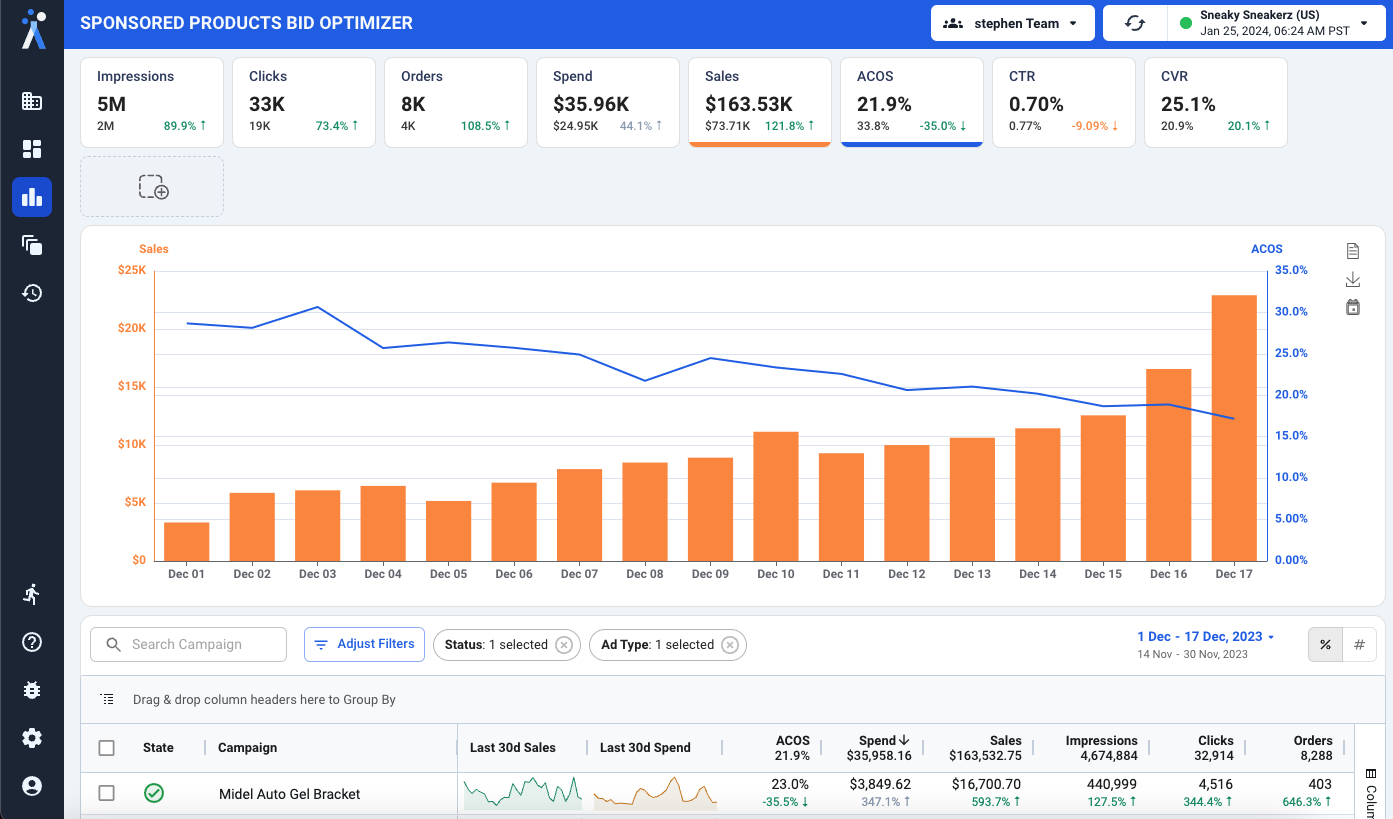
The Precision Mindset
DSP Is a Precision Instrument — Treat It Like One
The biggest mistake advertisers make with DSP is treating it like a blunt instrument. Throw money at it, hope for the best, wonder why it didn't work. That's not how this platform operates.
Treat DSP like a precision tool. Measure what's actually seen. Only pay for impressions that move revenue. And prove every dollar is strategically deployed.
The Anti-Black-Box Philosophy
We believe in transparency and control. No "set it and forget it" automation. No black boxes that claim to optimize your spend while hiding what they're actually doing. Every decision should be explainable: here's what we recommend, here's why, and here's what we expect to happen.
This is especially important with DSP and AMC, where the temptation to let the platform run on autopilot is strong. Don't let it. Amazon's default settings will happily spend your budget on off-Amazon placements with 5% viewability while you think everything's fine because the CPMs look cheap.
The Roadmap
Build the foundation first — each layer amplifies everything below it
Key Takeaways
- PPC first, always. Don't touch DSP until you've maximized efficient search spend.
- Start bottom-up. Retargeting → consideration → awareness. Prove value at each stage before moving up.
- Viewability is non-negotiable. Set minimums. Bid higher. Check inventory splits. If your ads aren't being seen, nothing else matters.
- Incrementality is everything. Use negations, NTB tracking, and AMC path-to-purchase to prove DSP is creating value — not just claiming it.
- AMC is no longer optional. Even without DSP, AMC audiences can supercharge your Sponsored Ads with surgical audience targeting.
- Video is the next frontier. OLV is underutilized and accessible. STV is for brands ready to invest in awareness. Both compound over time.
- Measure holistically. Don't evaluate DSP in a silo. TACOS, branded search volume, organic rank, and overall revenue trend are the true performance indicators.
Amazon's ad ecosystem is getting more sophisticated every quarter. DSP and AMC aren't just tools for enterprise brands anymore — they're rapidly becoming essential for anyone serious about growing on the platform.
The brands that master the full funnel — PPC, DSP, AMC, and video working together — are the ones that will own their categories in the years ahead.
Start small. Prove the concept. Scale what works. And never stop auditing.
This guide is based on years of managing Amazon DSP campaigns at scale, combined with insights from That Amazon Ads Podcast and our team's deep expertise in full-funnel Amazon advertising.